Astronomy is the first truly global venture. Its realm is "heavenly", far removed from the profane earthly boundaries. It has been developed by all the civilizations of this world, both Eastern and Western. It is a triumph of the human intellect, of human civilization.
Let us consider the contributions of some of the early civilizations:
-
 Our journey through the history of the science of astronomy begins in the Middle East, in the region known as the Fertile Crescent or Mesopotamia. This people
who lived in this region
are believed to have created the first "civilization" to have existed. Mesopotamians were the
first to observe and describe complex patterns in the motions of the heavens. Using mathematical
models to represent the patterns that they observed, they were able to predict the motions
and positions of the sun, moon, and planets with excellent accuracy. By about 2700 years
ago, they were able to predict lunar eclipses! They were able to develop accurate lunar
and solar calendars and as we have already discussed previously, introduced the concept
of constellations as a way to map the heavens. While the accomplishments of the Mesopotamian
astronomers may seem trivial in comparison to what we know today or even the achievements of
the latter civilizations, it is important to remember that their records and mathematical
modeling represent the first scientific study of the heavens ever undertaken by mankind. In
effect, the Mesopotamians created the scientific method.
Our journey through the history of the science of astronomy begins in the Middle East, in the region known as the Fertile Crescent or Mesopotamia. This people
who lived in this region
are believed to have created the first "civilization" to have existed. Mesopotamians were the
first to observe and describe complex patterns in the motions of the heavens. Using mathematical
models to represent the patterns that they observed, they were able to predict the motions
and positions of the sun, moon, and planets with excellent accuracy. By about 2700 years
ago, they were able to predict lunar eclipses! They were able to develop accurate lunar
and solar calendars and as we have already discussed previously, introduced the concept
of constellations as a way to map the heavens. While the accomplishments of the Mesopotamian
astronomers may seem trivial in comparison to what we know today or even the achievements of
the latter civilizations, it is important to remember that their records and mathematical
modeling represent the first scientific study of the heavens ever undertaken by mankind. In
effect, the Mesopotamians created the scientific method.
Click on the sketch of the zigurat dedicated to the moon-god Nanna
in the city of Ur to find out more about the Mesopotamians
 Bordering the Mesopotamians on the west was the Ancient Egyptian Civilization, another
of the world's great early civilizations. The Egyptian or the
Nile Valley civilization developed, as the name suggests, along the
banks of the river Nile in Egypt. Its long, narrow flood plain was a magnet for
life, attracting people, animals and plants to its banks, and providing ideal conditions
for the development of stable communities. Like their neighbours, the Egyptians
also studied the heavens, especially its cyclical patterns.
The known oldest Pharaonic astronomical texts date back to the ninth Egyptian dynasty
(c.2150BC). They give the names of thirty-six stars which rise within ten days of
each other at the same time as the sun. Egyptian astronomers also seem to have
recorded the appearance of Halley's comet some time in the period 1504-1450 BC.
The course of stars and planets was also a preocupation of the Egyptians. There are
indications that they considered the possibility of the earth moving about the sun.
The early Egyptian solar calendar of 365 days, which was already in widespread use
as early as 4200 BC, is the basis of our present calendar.
In comparing the achievements of the Mesopotamians and the Egyptians, there is
fair degree of uncertainty about who did what first and to what extent. What is clear
is that the two empires shared a common boundary and therefore, it is inevitable that
knowledge moved back and forth fluidly.
Bordering the Mesopotamians on the west was the Ancient Egyptian Civilization, another
of the world's great early civilizations. The Egyptian or the
Nile Valley civilization developed, as the name suggests, along the
banks of the river Nile in Egypt. Its long, narrow flood plain was a magnet for
life, attracting people, animals and plants to its banks, and providing ideal conditions
for the development of stable communities. Like their neighbours, the Egyptians
also studied the heavens, especially its cyclical patterns.
The known oldest Pharaonic astronomical texts date back to the ninth Egyptian dynasty
(c.2150BC). They give the names of thirty-six stars which rise within ten days of
each other at the same time as the sun. Egyptian astronomers also seem to have
recorded the appearance of Halley's comet some time in the period 1504-1450 BC.
The course of stars and planets was also a preocupation of the Egyptians. There are
indications that they considered the possibility of the earth moving about the sun.
The early Egyptian solar calendar of 365 days, which was already in widespread use
as early as 4200 BC, is the basis of our present calendar.
In comparing the achievements of the Mesopotamians and the Egyptians, there is
fair degree of uncertainty about who did what first and to what extent. What is clear
is that the two empires shared a common boundary and therefore, it is inevitable that
knowledge moved back and forth fluidly.
Click on the image of Sun God shining upon the Pharaoh and his Queen
to find out more about the Egyptians
 To the east of Mesopotamia lay the Harappan Civilization, more commonly known as the
Indus Valley Civilization. In common with other regions,
nomads settled in the rich fertile valleys along the banks of the Indus River and the
now-vanished Ghaggra-Hakra River or Sarasvati of the Rig Veda, a mighty river
that at one time ran parallel and west of the Indus, in the fourth millenium
B.C. By 2000 BC, they had established a thriving advanced civilization in
in the western part of South Asia, in what today is Pakistan and western India.
The Indus Valley civilization was the largest of the four ancient urban civilizations
of Egypt, Mesopotamia, India and China. Like elsewhere, astronomy began as
mere wonder at what was observed in the heavens above, grew into a systematic
observation and speculation, hence forward into scientific inquiry and interpretation,
finally emerging as a sophisticated discipline. At the same time, mystical
interpretations of the movement of stars and planets developed into
astrological science. Unfortunately, in spite of extensive excavation not much
is known about this civilization because their script remains undeciphered. The
civilization flourished for
thousand years and then due to unknown reasons suddenly vanished from the face
of earth around 1500 BC. Our primary source of of astronomy-related information are the
Vedic texts, religious texts, that have been passed down largely through oral transmission.
Details in this texts indicate a remarkably advanced civilization.
To the east of Mesopotamia lay the Harappan Civilization, more commonly known as the
Indus Valley Civilization. In common with other regions,
nomads settled in the rich fertile valleys along the banks of the Indus River and the
now-vanished Ghaggra-Hakra River or Sarasvati of the Rig Veda, a mighty river
that at one time ran parallel and west of the Indus, in the fourth millenium
B.C. By 2000 BC, they had established a thriving advanced civilization in
in the western part of South Asia, in what today is Pakistan and western India.
The Indus Valley civilization was the largest of the four ancient urban civilizations
of Egypt, Mesopotamia, India and China. Like elsewhere, astronomy began as
mere wonder at what was observed in the heavens above, grew into a systematic
observation and speculation, hence forward into scientific inquiry and interpretation,
finally emerging as a sophisticated discipline. At the same time, mystical
interpretations of the movement of stars and planets developed into
astrological science. Unfortunately, in spite of extensive excavation not much
is known about this civilization because their script remains undeciphered. The
civilization flourished for
thousand years and then due to unknown reasons suddenly vanished from the face
of earth around 1500 BC. Our primary source of of astronomy-related information are the
Vedic texts, religious texts, that have been passed down largely through oral transmission.
Details in this texts indicate a remarkably advanced civilization.
Click on the tablet showing what is believed to be a representation
of the Pleiades star cluster, also known as the seven sisters.
 Further to the east was the Chinese Civilization. As in other
cases, the civilization has its roots in nomads initially settling in the valleys and
flood plains of the Yangzi and the Yellow Rivers. In time, these people began organizing
and the earliest of the Chinese dynasties is now believed to have been the Xia ( (c.
2200 - c. 1750 BC) Until relatively recently, not much was known about these people and
in fact, most historians thought that the dynasty was a myth. But the archeological
record has shown otherwise, for the most part. What little is known indicates that the
Xia had descended from a wide-spread Yellow River valley Neolithic culture known as the
Longshan culture, famous for their black-lacquered pottery. Even though no known examples
of Xia-era writing survive, they almost certainly had a writing system that was a
precursor of the Shang dynasty's "oracle bones." Evidence from these Shang oracle bone
inscriptions shows that at least by the 14th century BC, the Shang Chinese had established
the solar year at 365 1/4 days and lunation at 29 1/2 days. In the calendar that the Shang
used, the seasons of the year and the phases of the Moon were all supposedly
accounted for.
Further to the east was the Chinese Civilization. As in other
cases, the civilization has its roots in nomads initially settling in the valleys and
flood plains of the Yangzi and the Yellow Rivers. In time, these people began organizing
and the earliest of the Chinese dynasties is now believed to have been the Xia ( (c.
2200 - c. 1750 BC) Until relatively recently, not much was known about these people and
in fact, most historians thought that the dynasty was a myth. But the archeological
record has shown otherwise, for the most part. What little is known indicates that the
Xia had descended from a wide-spread Yellow River valley Neolithic culture known as the
Longshan culture, famous for their black-lacquered pottery. Even though no known examples
of Xia-era writing survive, they almost certainly had a writing system that was a
precursor of the Shang dynasty's "oracle bones." Evidence from these Shang oracle bone
inscriptions shows that at least by the 14th century BC, the Shang Chinese had established
the solar year at 365 1/4 days and lunation at 29 1/2 days. In the calendar that the Shang
used, the seasons of the year and the phases of the Moon were all supposedly
accounted for.
Click on the picture of the Shang Oracle Bone
 The Mayan Civilization is probably the best-known of the
classical civilizations of Mesoamerica. Originating in the Yucatán around 2600 B.C.,
they rose to prominence around A.D. 200 in present-day southern Mexico, Guatemala,
northern Belize and western Honduras. Building on the inherited inventions and ideas
of earlier civilizations such as the Olmec, the Maya developed astronomy, calendrical
systems and hieroglyphic writing. The Maya were noted as well for elaborate and highly
decorated ceremonial architecture, including temple-pyramids, palaces and observatories,
all built without metal tools. They were also skilled farmers, clearing large sections of
tropical rain forest and, where groundwater was scarce, building sizeable underground
reservoirs for the storage of rainwater. The Maya were equally skilled as weavers and
potters, and cleared routes through jungles and swamps to foster extensive trade
networks with distant peoples.
The Mayan Civilization is probably the best-known of the
classical civilizations of Mesoamerica. Originating in the Yucatán around 2600 B.C.,
they rose to prominence around A.D. 200 in present-day southern Mexico, Guatemala,
northern Belize and western Honduras. Building on the inherited inventions and ideas
of earlier civilizations such as the Olmec, the Maya developed astronomy, calendrical
systems and hieroglyphic writing. The Maya were noted as well for elaborate and highly
decorated ceremonial architecture, including temple-pyramids, palaces and observatories,
all built without metal tools. They were also skilled farmers, clearing large sections of
tropical rain forest and, where groundwater was scarce, building sizeable underground
reservoirs for the storage of rainwater. The Maya were equally skilled as weavers and
potters, and cleared routes through jungles and swamps to foster extensive trade
networks with distant peoples.
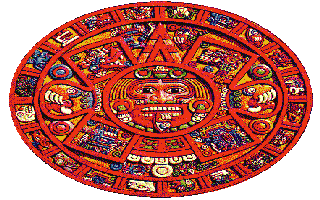
Of all the world's ancient calendar systems, the Maya and other Mesoamerican systems are the most complex, intricate and accurate. Calculations of the congruence of the 260-day and the 365-day Maya cycles is almost exactly equal to the actual solar year in the tropics, with only a 19-minute margin of error. Maya astronomer-priests looked to the heavens for guidance. They used observatories, shadow-casting devices, and observations of the horizon to trace the complex motions of the sun, the stars and planets in order to observe, calculate and record this information in their chronicles, or "codices". From these observations, the Maya developed calendars to keep track of celestial movements and the passage of time. The Maya also kept detailed records of the moon, although these do not seem to constitute a formal lunar calendar.
Click on the picture of the Mayan Calendar
At the same time, we should note that as impressive as the achievements of these civilizations are, it is not until we go beyond predictions and start asking the question "how" that science comes into own. But these early civilizations certainly started us solidly down that path by providing us with enormous amounts of data about the cyclical patterns of the heavens. Much of what followed would not have been possible without the foundation laid by these early civilizations.
 Oldest of the Sciences